WILL NEED TO ADD COST OF 2 CARRIER CLOTHS. LIGHT WEIGHT COTTON
i’ll need to price radiator hose to wrap bundles on
Feb 13—. shifted zoom info.. did not catch. was good until then…. emailed him to see if they recorded…
Micro grant——1st of Month
Dates: Oct 1, March 15
;NEED
-evidence of being a professional artist
developed artistic practise
MEET CRITERIA- created work recognized by community
-presented work to an audience
-developed skills in a manner acceptable for your art
-recognized as a PEER by other professionals- can have letter of support…
-received compensation for work. o
-recognition by thers in your art. form
categories. : -emerging artist….. then he dropped off
jan 28
panels can only be 7 ft as I only have 8 feet of work top and need width of roller on. end of table …
jan 26
I don’t think I fall into any category for sask arts right now
Creative sask is for selling?
Looked at sask galleries for sizes… I think settle on a bit bigger than Mann?
The hemp looks nice BUT for its. price, it would need to be terrific, which I don’t think we will see much difference.. so ditch the hemp and go mostly cotton? bit of silk…
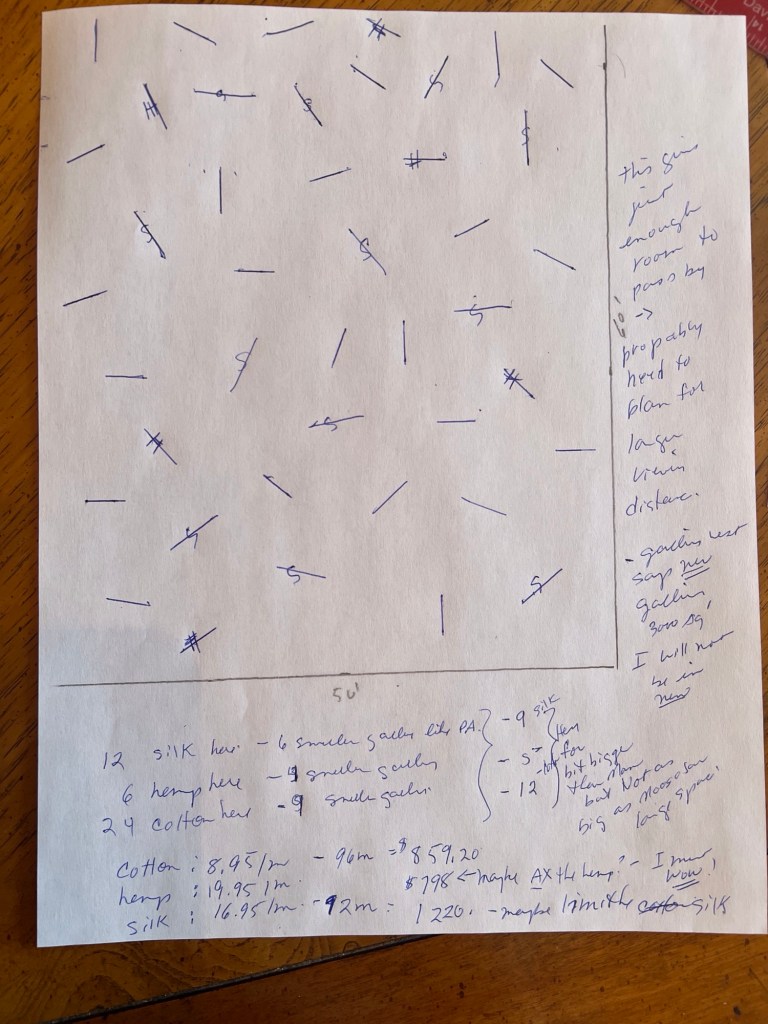
maybe: cotton- 15. $ 1074
silk. – 5 . $678
$1752 for fabric. ?¿
I would have propane tanks to refill. Will need for scour of cotton— 15 times.. 2 scour per tank, so 7 tanks — $15. = $105
scour silk just needs dish soap and wheat bran (about $4.00)
I need to steam each fabric at 2 steams per tank ( most tanks have a bit left) 20 fabrics… at such long panels, I think I could only get 1 cotton at a time, 2 silks
7 x $15 = $ 105 for steam cotton
3 x $ 15 = $45 for steam silk
total : 105 + 105 + 45 = $ 255
jan 25
have both hemp samples… look promising by weight…. need to find someone with live plants so I can steal a few leaves from and do test samples
jan 24
have not had good success in past with linen… have a sample now and think it is too dense i weave to accept colours the way I want.. The samples of hemp I have coming are a cotton blend.. will see weight and weave.
Medium organic cotton is good. silk is great.. COULD. go with light cotton, but it is almost sheer…. not sure if dense enough to. create visual blocks for pathways…. if hemp does not work then……
.1use only 2 distinct sources
2. go with SOME lightweight
3. go to Pa and get some of the textural material I have worked on in past…. material is kind of fuzzy…
4. could maybe look at jersey????
jan 22
Instead of velcro will go with eyelets…. Can either have fish line come straight to eyelet or use something like a shower hook to attach to willow.
am leaning towards doing away with the willow and having 4 lines straight to each panel..
Have ordered sample of hemp.. to see if suitable.
jan 20
however Ido have 20+ serviettes in cotton that I died at the same time I died my silks that are very nice…. maybe I just got better at the process??? things to ponder…
jan 19
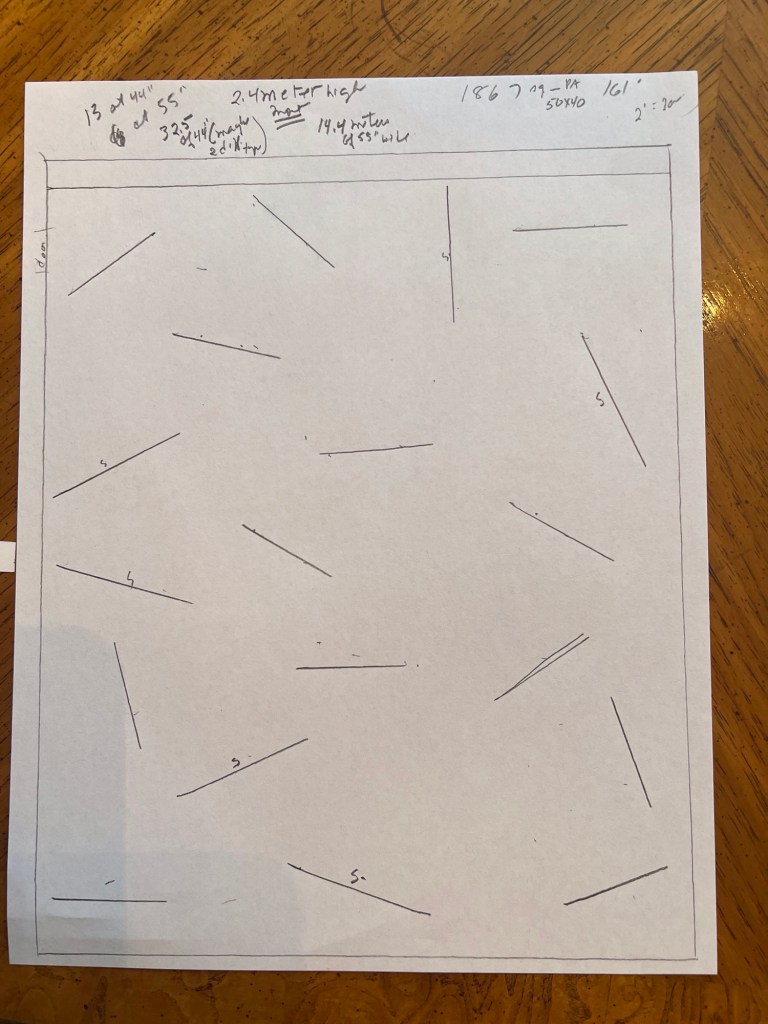
allow for walking through spaces—single—ones with s are 55” wide. calculate all at 2.4 meter (8ft).
need 32,5 of 44”. $9.95 = $129.35
second 44” (part of 32.5) is $19.95 = $199.5
silk 14.5 meter $16.95=. $245.80
I. know I will not be buying .5 more of any.. this is rough price estimate
If I were to go All silk $662.90
looking at my samples, I am leaning toward 60 to 65% silk =$477.99
30% cotton = $140.30
10% hemp = $93.80
total: $ 712
****I NEED TO GO BACK ANOTHER DAY AND CHECK MY. MEASUREMENTS AND CALCULATIONS…..
THOUGHT. — large wall graphics¿ / labels re what plants. used in dyes and printing….letters. on wall???
jan 19
HORRERS….. I went through my box of old sample and into my books of past work. that has samples……..COTTON/LINEN GIVES TERRIBLE RESULTS compared to silk… on looking at the cotton results I wonder why I ever kept going.. silk absorbs natural dyes much more readily than cotton.. and results are more eye pleasing.. DO I GO TO MOSTLY SILKS????
$16.95 ¿. m. $9.95 for cotton.. silk is a wider roll 55”, cotton 44” making silk harder to bundle….
Jan 17
Fabric – Cotton Organic Lightweight
Fabric – Cotton Organic Medium Weight
3) I would check out the following cottons:
Lightweight: https://maiwa.com/collections/yardage/products/fabric-cotton-organic?_pos=10&_fid=6ca521a2e&_ss=c
Medium weight: https://maiwa.com/collections/yardage/products/fabric-cotton-organic-medium-weight?_pos=11&_fid=6ca521a2e&_ss=c
I. Could Put the hemp towards the middle , then plan for cotton , then silk like in layers of the trail as one sees coming down the hill or I could just blend.. I will need to make a scale drawing to see how many panels required, thus how. much material required…
JAN 16TH RESPONSE AS PER SUITABLE FABRICS… (supplier runs many dye clinics as goes around world)
Lightweight: https://maiwa.com/collections/yardage/products/fabric-cotton-organic?_pos=10&_fid=6ca521a2e&_ss=c
Medium weight: https://maiwa.com/collections/yardage/products/fabric-cotton-organic-medium-weight?_pos=11&_fid=6ca521a2e&_ss=cThis is a great blend: https://maiwa.com/collections/yardage/products/fabric-hemp-organic-cotton-natural?_pos=3&_fid=6ca521a2e&_ss=c
Popular weight for silk: https://maiwa.com/collections/yardage/products/fabric-silk-habotai-8mm-weight-55-width?_pos=6&_fid=168cc5f9e&_ss=c
And a heavier weight: https://maiwa.com/collections/yardage/products/fabric-silk-charmeuse-16mm-weight?_pos=7&_fid=168cc5f9e&_ss=cOur organic cotton is grown in Nagpur in Central India, and spun and woven in Coimbatore South India. Maiwa works directly with the farmers, spinners and weavers. Any of our cotton fabrics that are listed as Organic Cotton are GOTS certified organic on all three levels.
All the Chinese mill silk fabrics we carry come from a distributor who works directly with silk weaving factories in the Zhejiang Province of China. Technically speaking there is not official fair trade certification. These fabrics are prepared for dyeing, so there are no dyes/chemicals used and not much labour as much of the spinning and weaving process is very automated. This supplier also does on-site checks regularly and the workers are paid fairly as they are considered to have a skill in working with silk fibres. The environment of the factories is clean and absolutely no child labour.
Kind regards,
Hana
as of jan 15
I have been researching prices on light weight organic cotton, hemp, silk.. maiwa is competitive and I trust they will give as ordered…
-I want many of the panels to tower over me… like trees in the forest
-The panels can have different leaves on bottom than top…. forest floor, especially if panels just graze the floor
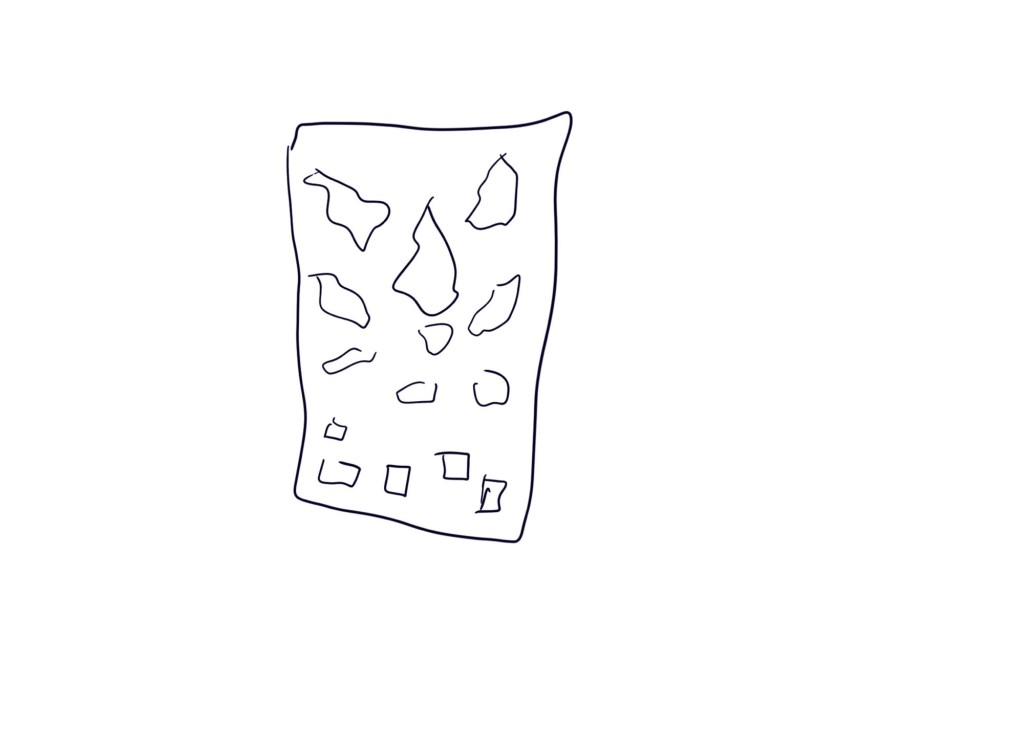
Leavess/weeds/grasses can be places where I want… could be grasses along bottom with smaller leaves???
– panels can vary in width
– most panels should be 2+ m high
-fabric needs to be organic – this project is organic.
– 3 types of fabric. (maybe 1 little lone piece of silk) — 65% medium to lightweight cotton – does not need to be “hand” woven. — 20% linen light weight — 15% (or less) hemp. (this depends on availability). *** this reflects the predominately spruce forest on my walk – other trees such as poplar, pine and maple do have a stake, as do things like water birch which lye on the edge where light can more readily access the tree, thus I think of the silk— lighter, airy..
I do not want a variety of the fabric type to distract from the art. 3, 5 etc are good numbers to think of as they are more likely to tip if they were a container and thus have more potential energy, you eye keeps moving, not in a state of rest. I can live with the silk towards the end as a jolt from the expected, like coming upon a tree not normally in this forest.
I will not hem — this contains, restricts – there is no restriction in my walk— some deviations in the path, but loose and flowering, like the cleaves rustling in the breeze. (i know pine needles do not rustle— but the limbs do sway )
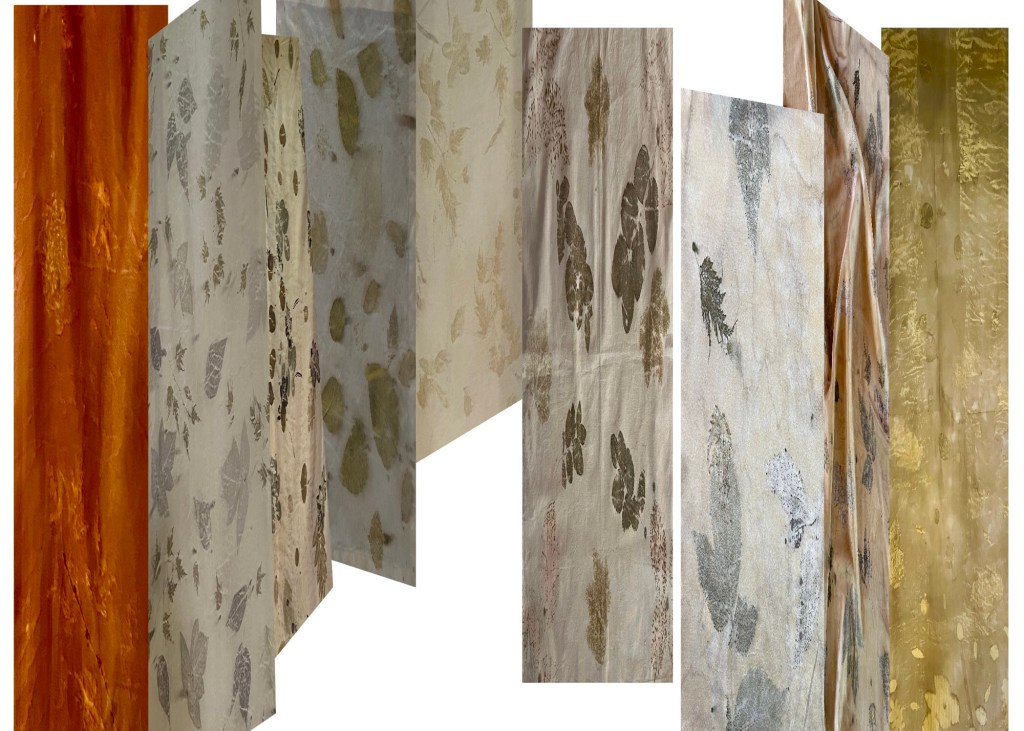
PROBLEMS. WITH ORGANIC——-not bleached.. cottons are beige, hemp is grey/green. how much will this mask the leaf patterns.. will You see the delicate shades of dandelion over the unbleached fabric… maybe need to go to silk when doing lighter dyes???
RECOMMENDED TO SURGE EDGES TO PREVENT FRAYING…
OLDER THOUGHTS IN JAN.
DO I NEED to. have full width of fabric for all or some skinnier……..
cloth does not need to be perfect. BUT… NOT ALL WILL WORK WITH THIS PROCESS SO i either need samples send or i need to see cloth. CAN NOT BE ANY BLEND!!!
tight weaves are hard to get good dying/results……. need to examine fabric if weave type not indicated
JUST READ ABOUT DIFF.. ORGANIC COTTON TO COTTON WITH SPRAYS AND OTHER TREATMENTS…. THINK OF WHEAT-NON-ORGANIC IS SUBJECTED TO ANHYDROUS, A MULITUDE OF WEED AND INSECT SPAYS, AND DESICATION… organic cottons take natural dyes better.. more evenly and intense…. I CAN BUY ORGANIC… IS IT PART OF MY PACKAGE¿. everything else I use is organic, including collecting rust water
KALA. COTTON
MUSLIN
think of hems on fabric
lengths and widths can differ
fabric type. can differ
dyes will differ… all reflecting the diverse nature of a forest.
In proposal stress this is memores of my walks in my forest produced in my studio with dyes I. have made from plants on my acreage and leaves/flowers/grasses roots from my acreage.
this is a process.
different stages of the season give different plants. so product will reflect what season I am working in. example—dandelion or rose hips
make more hangings than less.. want to fill a space..
people need to wind through the space, some hangings will make you. turn…
I had initially thought the walk needed to find things, but now am thinking that the walk is about the art. the art will bring people to my forest
process: finding/collecting plants/roots for dye — making. dye ( two processes… 1) sun extraction… very appealing to me as low environmental impact…..disadvantage is it takes at least a month for the dye to extract and by that time the leaves are no longer in prime for use…. 2) heat extraction. disadvantage using propane. I MIGHT EXPERIMENT WITH PUTTING MY LEAVES FOR EXTRACTION IN MY BOILER THAT IS PRODUCING STEAM FOR MY DYE/PLANT MATERIAL ..SOME PLANT MATERIALS LOSE THERE TANNIN WHEN BOILED SONCOULD NOT USE THIS METHOD ON THOSE. )
process: having material in dye for a period of time…. most people heat their material in the dye… I prefer to let time do the bonding for me as heating is just a use of energy ..
process: gathering plant material to place on the dyed fabric. This needs to be done at time of taking fabric out of dye as the plants lose tannin , freshness quickly once picked.
process:place a carrier on table. _-thin… squeeze most of dye from fabric so it is JUST a bit damp…(tannins work better if fabric. has some moisture). place leaves/grasses/flowers on fabric —- on large widths will need to know that you will be doing a mirror image because of the fold…OR with some help, the damp blanket can be placed over found objects, then rest of fabric folded over—— NEED A GOOD CARRIER 3 FOR THIS METHOD… can get bulky for rolling….
proces: place carrier on. then long roller. With pressure roll sandwich of fabrics around roller—-tightly—- use good string and completly wrap end to end and back
Process; bundle can sit overnight but should not dry… place bundle in pipe over water and steam fort 1 1/2 hours
process: once cool unwrap, discard organic sand hang out of sun to dry.
I LIKE WALkiNG in my forest.. each trip shows me something new.. a violet here, a feather or mushroom. Tracks of animals that habit my forest and have crossed my trail. In the summer my forest offers a cool respite from the blazing sun. in the winter it gives me shelter from the ravaging winds.. a bird flies up on my path, a squirrel chatters at me.. a glimpse of a deer as it bounds away. then there is the underbrush.. tangles of large trees the wind has uprooted, ferns sprout in here. wild currents, raspberries gooseberries to be plucked. I have a treasure in my own backyard.
ABOVE CAN CREATE A BSASIS FOR MY ARTIST STATEMENT….
 Riverview Arts